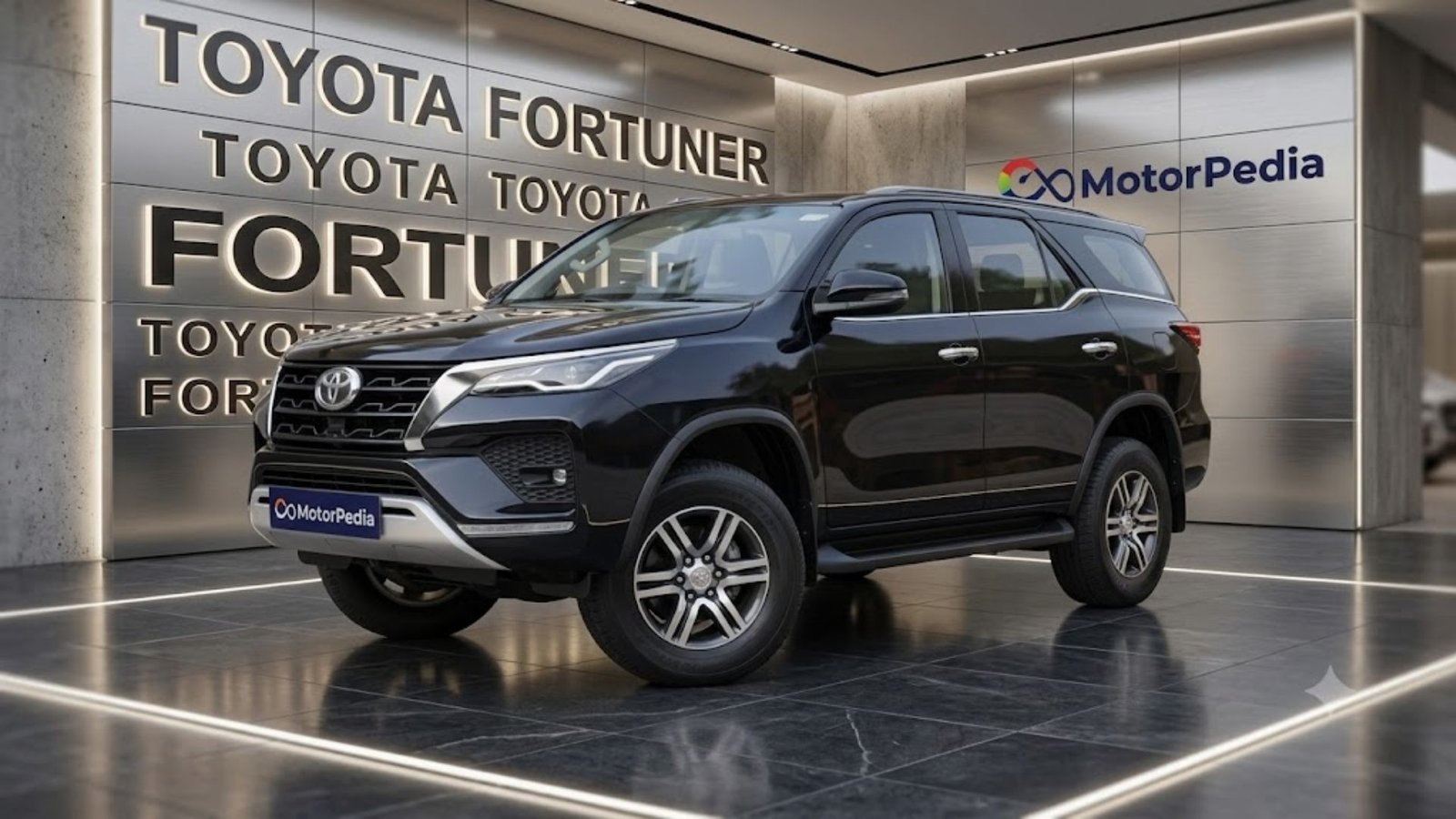
Toyota Fortuner 2026-There are very few SUVs in India that command the kind of respect the Toyota Fortuner does. Pull up next to one at a traffic signal, and you’ll notice heads turning — not because it’s flashy, but because it simply looks like it means business. For over a decade, the Fortuner has been the go-to choice for buyers who want a proper body-on-frame SUV that can handle bad roads, long highway runs, and everything in between, without breaking a sweat.
Now, with rumours of a next-generation model swirling around, and Toyota already having launched the new Hilux pickup that shares its underpinnings with the Fortuner, a lot of buyers are stuck in a genuinely tricky spot — do you book the current Fortuner today, or hold off for the updated 2026 version? In this article, we’ll walk through everything reportedly known about the Toyota Fortuner 2026, its expected price, likely changes, and how it might stack up against the competition, so you can make a more informed decision.
Why Is Everyone Talking About the Fortuner Right Now?
Toyota Fortuner 2026-The buzz around the Toyota Fortuner 2026 didn’t come out of nowhere. Toyota recently rolled out the new-generation Hilux in India, and since the Fortuner and Hilux have always shared a lot of their mechanical DNA, the Hilux’s arrival is being widely seen as the clearest hint yet of what’s coming for the Fortuner. Sharper LED lighting, a more premium cabin, and updated technology — much of what’s now on the Hilux is expected to eventually trickle down to the Fortuner as well.
On top of that, Toyota has already showcased hybrid and flex-fuel versions of the Fortuner at international motor shows, and the brand’s broader push towards hybrid powertrains in India — visible in models like the Innova Hycross and Urban Cruiser Hyryder — has fuelled speculation that the next Fortuner could get some form of electrification too, most likely a 48V mild-hybrid diesel setup rather than a full strong-hybrid system.
That said, Toyota has not officially confirmed a launch date, final specifications, or pricing for the updated Fortuner. Everything currently doing the rounds is based on industry reports, spy shots, and educated speculation from people tracking Toyota’s India roadmap closely.
Toyota Fortuner 2026 Key Details at a Glance
Toyota Fortuner 2026-Here’s a simple summary table to help you understand where things currently stand — both for the existing Fortuner and what’s reportedly expected with the update.
| Detail | Current Fortuner (2026) | Next-Gen Fortuner (Expected) |
|---|---|---|
| Ex-Showroom Price Range | Roughly ₹34.16 lakh – ₹49.59 lakh | Likely ₹36 lakh – ₹52 lakh (expected hike) |
| Launch Status | Already on sale | Not officially confirmed |
| Engine Options | 2.7L petrol, 2.7L/2.8L diesel | Same base engines, reportedly with added 48V mild-hybrid diesel |
| Power Output | Up to around 201 hp (diesel AT) | Broadly similar, hybrid assist likely for smoother low-end power |
| Mileage (ARAI Claimed) | 10.3–14.6 kmpl depending on variant | Slightly improved with mild-hybrid assistance (expected) |
| Transmission | 6-speed manual and automatic | Automatic likely to continue as the preferred choice |
| Expected New Features | — | 12.3-inch touchscreen, bigger digital cluster, panoramic sunroof, updated safety suite |
| Key Rivals | Skoda Kodiaq, MG Gloster, Jeep Meridian, Mahindra Scorpio-N | Same rivals, with sharper competition expected |
| Expected Launch Timeline | — | Late 2026 or early 2027 (not officially confirmed) |
As always, treat the “expected” column as an informed estimate rather than a confirmed spec sheet — Toyota India hasn’t put out an official statement yet.
A Quick Recap: Why the Fortuner Became India’s Favourite Big SUV
Toyota Fortuner 2026-Toyota first launched the Fortuner in India back in 2009, and it didn’t take long for it to become the default aspirational SUV for a certain kind of buyer — the one who wanted something rugged, dependable, and unmistakably premium without going the luxury SUV route. The 2021 update brought a fresher design, a bump in features, and more power, and even years later, the Fortuner continues to comfortably sit at the top of its segment despite newer, more feature-loaded rivals entering the market.
Part of that staying power comes down to something that’s hard to put a price on — trust. Toyota’s reliability record in India is practically legendary, and the Fortuner’s resale value remains one of the strongest in the industry. A well-maintained five-year-old Fortuner can still fetch a surprisingly good price, which says a lot about how much buyers continue to value the badge.
Expected Price: Is the Toyota Fortuner 2026 Still Worth It?
Toyota Fortuner 2026-This is the question most buyers actually care about. The current Fortuner already sits in a fairly premium bracket, starting around ₹34.16 lakh ex-showroom and climbing all the way up to nearly ₹50 lakh for the fully-loaded 4×4 diesel automatic variant. With the next-gen update expected to bring a mild-hybrid diesel option, a bigger touchscreen, and other feature additions, industry reports suggest a price hike of anywhere between ₹1.5 lakh to ₹2 lakh over the current range — though this, again, is speculative until Toyota confirms it officially.
Here’s the honest, no-fluff opinion: even at nearly ₹50 lakh, the Fortuner has rarely struggled for buyers, and that’s unlikely to change with the update. What you’re paying for isn’t just an SUV — it’s the reassurance of Toyota’s after-sales network, the body-on-frame toughness that few rivals can match, and a resale value that genuinely softens the blow of that steep upfront cost. That said, if your budget is tight and you don’t specifically need the body-on-frame ruggedness, some competitively priced monocoque SUVs might actually offer better value for daily city use.
Engine, Performance and Real-World Usability
Toyota Fortuner 2026-The current Fortuner is offered with a 2.7-litre petrol engine and 2.7-litre or 2.8-litre diesel options, the latter already having received a 48V mild-hybrid system on select variants for smoother low-end response and marginally better efficiency. For the next-gen model, reports suggest this mild-hybrid diesel setup could be extended further, or refined, rather than a completely new engine being introduced — Toyota tends to favour proven, reliable powertrains over frequent overhauls, and the Fortuner’s diesel motor has built a strong reputation over the years.
In real-world driving, the Fortuner’s diesel automatic is genuinely well suited to Indian conditions — strong low-end torque for city driving, confident overtaking power on highways, and enough ground clearance and 4×4 capability (on select variants) to handle rougher patches without drama. The mild-hybrid system, where fitted, mostly helps with smoother stop-start behaviour in traffic and a slight bump in fuel efficiency, rather than transforming the driving experience altogether.
Mileage, as per ARAI figures, currently ranges between roughly 10.3 kmpl for the petrol and up to 14.6 kmpl for the diesel automatic. Real-world figures tend to run a little lower, especially in heavy city traffic, so anyone cross-shopping should factor in realistic running costs rather than going purely by brochure numbers.
What It’s Actually Like to Live With a Fortuner
Toyota Fortuner 2026-Owning a Fortuner in daily life is a bit of a mixed experience, and it’s worth being upfront about that. In the city, its sheer size means parking can be a genuine challenge in tighter spaces, and low-speed manoeuvring, while manageable, isn’t as effortless as it is in a compact SUV. The turning radius and overall footprint mean you do need to plan your parking spots a little more carefully than you would with a smaller car.
Where the Fortuner truly comes into its own is out on the highway and on longer trips. That commanding driving position, the stability at speed, and the sheer confidence it gives you over broken roads or unexpected gravel patches is genuinely hard to replicate in most monocoque SUVs. If your driving involves regular trips outside the city — hill stations, family road trips, or routes with unpredictable road quality — this is exactly the kind of vehicle that makes those journeys noticeably less stressful.
Cabin comfort has generally been a strong point too, with the third row usable for shorter trips, though like most 7-seaters in this segment, adults may find the last row a bit tight for long journeys. If the next-gen model does bring a panoramic sunroof and updated seat upholstery as expected, that overall sense of premium-ness inside the cabin should only improve further.
Safety and Software: What to Expect
Toyota Fortuner 2026-Toyota has been steadily improving the safety kit across its India lineup, and the current Fortuner already comes with a reasonably strong set of safety features on higher variants, including multiple airbags, stability control, and a 360-degree camera on top trims. For the next-gen model, reports suggest an updated safety suite, potentially bringing more advanced driver-assistance features in line with what Toyota has been rolling out globally.
Toyota Fortuner 2026-On the technology front, expect a larger 12.3-inch touchscreen infotainment system and a bigger digital instrument cluster, replacing the current setup with something noticeably more modern. Wireless Android Auto and Apple CarPlay, along with connected car features, are also likely to be part of the package, though the exact specification for the India-spec model isn’t officially confirmed yet.
Toyota Fortuner 2026 vs Rivals: How Does It Compare?
Toyota Fortuner 2026-The full-size SUV segment has genuinely gotten more competitive over the last couple of years, and the Fortuner, despite its dominance, will need to keep up. Here’s an honest look at how it stacks up.
Toyota Fortuner vs Skoda Kodiaq
Toyota Fortuner 2026-The Kodiaq brings a more refined, car-like driving experience along with a strong feature list, including a digital cockpit and three-zone climate control. What it lacks, though, is the Fortuner’s body-on-frame ruggedness and proper 4×4 capability, which matters a lot to buyers who genuinely venture off the beaten path.
Toyota Fortuner vs MG Gloster
Toyota Fortuner 2026-The Gloster has tried to compete on features and a lower starting price, offering a loaded spec sheet. However, it hasn’t been able to match the Fortuner’s brand trust, resale value, or long-term reliability reputation in the Indian market.
Toyota Fortuner vs Mahindra Scorpio-N
Toyota Fortuner 2026-The Scorpio-N has genuinely impressed with its value-for-money proposition, offering solid off-road capability at a noticeably lower price point. For buyers watching their budget closely, it’s a strong alternative, though the Fortuner still holds an edge in outright refinement and resale value.
Toyota Fortuner vs Jeep Meridian
Toyota Fortuner 2026-The Meridian offers a more premium, tech-loaded cabin experience, but Jeep’s relatively limited service network in India compared to Toyota’s extensive dealership presence remains a genuine consideration for buyers in smaller cities and towns.
Who Should Consider Buying the Toyota Fortuner 2026?
- Buyers who need genuine off-road capability and body-on-frame toughness, not just SUV looks
- Families who frequently travel long distances or to areas with rough road conditions
- Buyers who prioritise resale value and long-term reliability over outright features
- Those who value Toyota’s extensive service network, especially outside major metro cities
Who Should Probably Consider Alternatives?
- Buyers who mostly drive within the city and rarely need off-road capability
- Those on a tighter budget who’d rather get more features at a lower price point
- Buyers who prioritise a smoother, more car-like ride over outright ruggedness
- Anyone who needs a vehicle immediately and can’t wait for the next-gen model’s uncertain launch timeline
Ownership and Maintenance Cost: What to Expect
Toyota Fortuner 2026-This is genuinely one of the Fortuner’s strongest areas. Toyota’s service costs in India have traditionally been reasonable compared to rivals, and parts availability is rarely an issue, even in smaller towns, thanks to the brand’s wide dealership network. The diesel engine, in particular, has built a reputation for being tough and dependable over high mileage, which is a big reason why so many Fortuners are still running strong well past the 1.5–2 lakh km mark.
Resale value remains a major selling point too — Toyota SUVs, and the Fortuner especially, tend to hold their value noticeably better than most rivals in the segment. If the mild-hybrid system is expanded in the next-gen model, it could also mean marginally better fuel efficiency, which helps offset some of the running costs over a typical 7–10 year ownership cycle that many Fortuner buyers tend to follow.
Honest Pros and Cons
Pros:
- Unmatched brand trust and resale value in the segment
- Genuine body-on-frame toughness and 4×4 capability on select variants
- Strong, dependable diesel engine with a proven track record
- Wide service network, even in smaller towns and cities
- Expected feature and tech upgrades with the 2026 update
Cons:
- Expected price hike could push it further into premium territory
- Not the most car-like or agile to drive in tight city conditions
- Fuel efficiency remains modest compared to monocoque rivals
- Next-gen launch timeline is not officially confirmed, so buyers may face a wait
- Third-row space remains tighter than some rivals for taller passengers
Final Verdict: Should You Buy Now or Wait for the Toyota Fortuner 2026?
Toyota Fortuner 2026-Here’s the practical, honest take. If you need a Fortuner right now — for a specific trip, a business need, or simply because the current model already ticks every box for you — there’s genuinely no strong reason to wait. The current Fortuner remains a thoroughly capable, dependable SUV, and Toyota’s ownership experience is hard to beat.
However, if you’re not in a rush and can hold off for several months, waiting for the Toyota Fortuner 2026 could make sense, especially if the expected mild-hybrid diesel, bigger touchscreen, and updated safety features matter to you. Just be mentally prepared for a likely price increase and an launch timeline that, as of now, remains unofficial and could shift further.
Our honest advice: don’t let the wait drag on indefinitely if you need the vehicle for practical, near-term use. But if you’re the patient type and want the most updated version, keeping an eye on official Toyota announcements over the next few months would be the smart move.
Frequently Asked Questions (FAQs)
Q1. Is the Toyota Fortuner 2026 officially confirmed with new features? Not entirely. The current Fortuner is already on sale with periodic updates, but the next-generation model with major feature and design changes has not been officially confirmed by Toyota India yet.
Q2. What is the expected price of the Toyota Fortuner 2026? Based on current reports, the next-gen Fortuner could be priced around ₹36 lakh to ₹52 lakh ex-showroom, roughly ₹1.5–2 lakh more than the current range, though this isn’t officially confirmed.
Q3. Will the Toyota Fortuner 2026 get a hybrid engine? Reports suggest an expanded 48V mild-hybrid diesel setup is likely, rather than a full strong-hybrid powertrain, though Toyota hasn’t confirmed final engine specifications.
Q4. When will the new Toyota Fortuner launch in India? There’s no official launch date yet. Industry reports suggest a likely window of late 2026 or early 2027, but this remains speculative.
Q5. Should I buy the current Fortuner or wait for the 2026 update? If you need the vehicle soon, the current Fortuner remains a solid, capable choice. If you can wait and want the latest features, holding off for the next-gen model could be worth it.
Q6. What are the main rivals of the Toyota Fortuner in India? Key rivals include the Skoda Kodiaq, MG Gloster, Jeep Meridian, and Mahindra Scorpio-N.
Q7. Is the Toyota Fortuner good for daily city driving? It can be used daily, but its size and turning radius make it less nimble than smaller SUVs in tight city conditions. It’s best suited to buyers who also value highway and off-road capability.