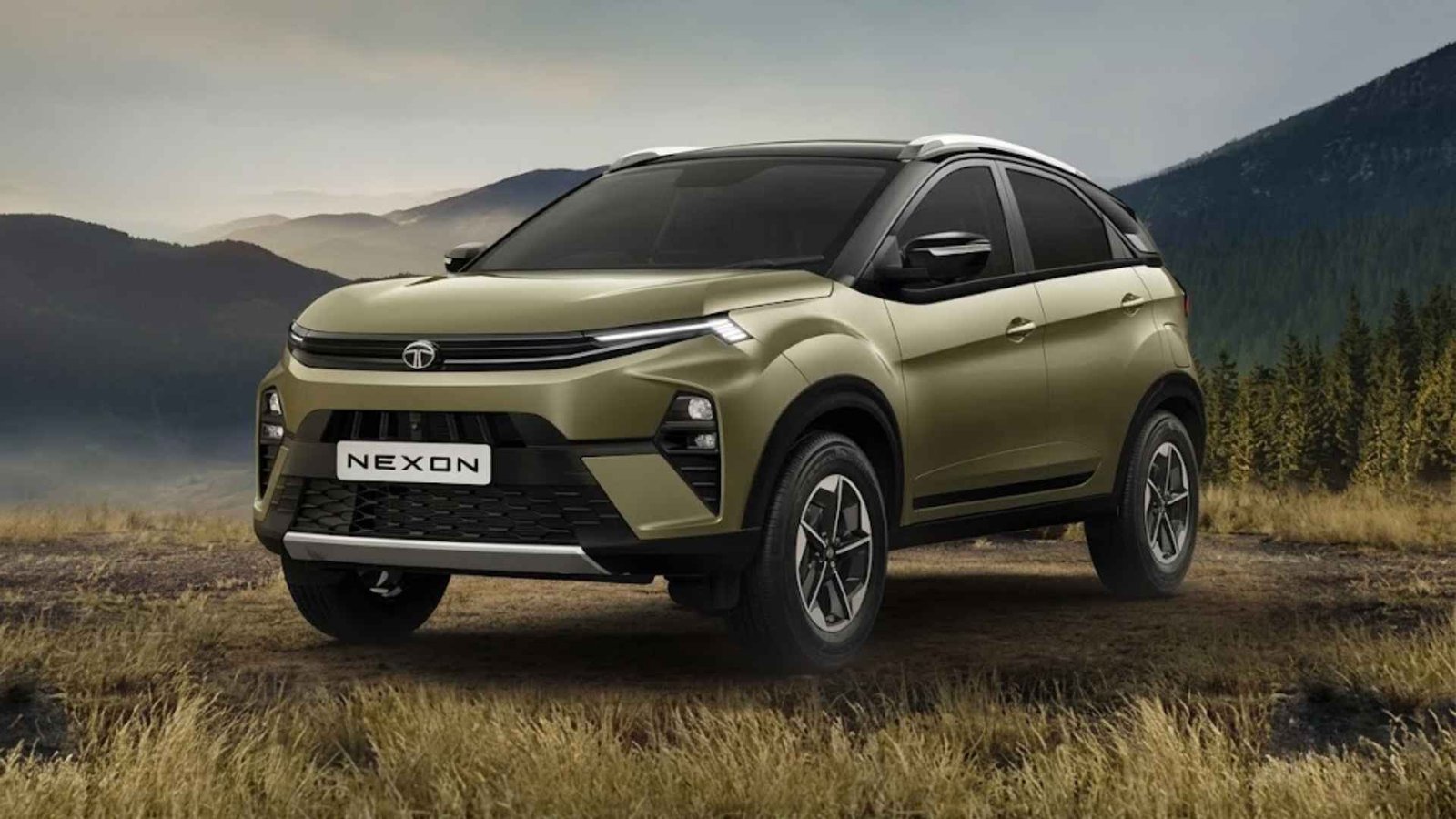
Tata Nexon-Ask any Indian car buyer to name a safe, feature-rich compact SUV under ₹15 lakh, and there’s a good chance the Tata Nexon comes up in the first breath. It has been sitting at or near the top of SUV sales charts for a while now, and it’s not just marketing noise — this Tata Nexon review is our honest attempt at explaining why it continues to sell so well, and more importantly, whether it’s actually the right car for you.
We’re not here to just repeat the brochure. We’ll talk pricing, real mileage numbers, safety tech, ownership costs, and yes, the things Tata doesn’t put on billboards too.
Tata Nexon Key Details at a Glance
Here’s a quick table before we dive deep — bookmark this if you’re comparing variants later.
| Detail | Information |
|---|---|
| Ex-showroom Price Range | Around ₹7.37 lakh to ₹14.40 lakh |
| Engine Options | 1.2L Turbo-Petrol, 1.5L Diesel, Turbo-Petrol CNG |
| Petrol Power Output | Around 120 PS, 170 Nm |
| Diesel Power Output | Around 113-115 PS, 260 Nm |
| CNG Power Output | Around 99-100 PS, 170 Nm |
| Transmission Options | 5-speed Manual, 6-speed Manual, 6-speed AMT, 7-speed DCA (automatic) |
| ARAI Mileage Range | Roughly 17-24 kmpl (varies by engine/fuel type) |
| Real-world Mileage (owner-reported) | Around 15-17 kmpl for petrol/diesel; CNG owners report much higher |
| Safety Rating | 5-star Bharat NCAP |
| Airbags | 6 airbags standard |
| Ground Clearance | Around 208 mm |
| Boot Space | Around 321 litres (CNG variants retain this too) |
| ADAS | Available on select top-end automatic variant |
| Seating Capacity | 5 |
| Key Rivals | Maruti Brezza, Hyundai Venue, Kia Sonet |
Keep these numbers handy — we’ll unpack most of them as we go.
Tata Nexon Design: Does It Still Turn Heads?
The Nexon has always had that slightly coupe-ish, sporty silhouette that sets it apart from the boxier SUVs in its class. The sloping roofline running into the C-pillar, sharp body lines, and thick black cladding give it a stance that still looks fresh even a few years after its last major facelift.
Up front, the connected LED DRL setup and projector headlamps give a premium first impression, while the rear gets a connected LED tail lamp strip with a small welcome animation — a detail that owners genuinely seem to enjoy showing off to friends. Tata Nex The alloy wheel design with aero inserts adds a nice sporty touch without looking over the top.
Reportedly, Tata has been testing a heavily updated version of the Nexon with styling cues borrowed from the Curvv, though this update is not officially confirmed yet and details should be treated as expected rather than final until Tata makes an official announcement.
Cabin and Features: Where the Nexon Feels Genuinely Premium
Step inside, and this is honestly where the Nexon punches above its price bracket. The dashboard is dominated by digital screens Tata Nex — a large touchscreen infotainment unit paired with a fully digital instrument cluster — and the two-spoke steering wheel with an illuminated Tata logo adds a nice touch of theatre.
Comfort and Practicality
Front seat comfort is genuinely good, and the elevated driving position gives a confident, “I can see everything” feel that SUV buyers love. Tata Nex Rear seat space is decent for average-sized adults, though the sloping roofline does eat into headroom a bit for taller passengers — something to check personally on a test drive if you’re over 6 feet tall.
The boot space of around 321 litres is respectable for the segment, and notably, the CNG variants don’t compromise on this because the cylinder is packaged without eating into usable boot space — a smart engineering touch that a lot of rivals still struggle with.
Tech and Connectivity
The touch-based automatic climate control panel looks modern and responds well, and there are still physical toggle switches for frequently used functions, which is a thoughtful balance between touch-tech and usability. Features like a panoramic sunroof, JBL sound system, wireless charging, and connected car tech (remote functions via a smartphone app) round out what is a genuinely feature-rich cabin for the price.
Engine and Performance: Petrol, Diesel or CNG?
One of the Nexon’s biggest strengths is genuine engine choice — something increasingly rare in this segment.
1.2-Litre Turbo-Petrol
This is the volume seller, and for good reason. It offers lively performance for city use and enough mid-range punch for occasional highway overtakes, though initial throttle response can feel a touch modest at very low speeds. It’s available with a 5-speed manual, 6-speed manual, 6-speed AMT, and — on higher variants — a smooth 7-speed dual-clutch automatic (DCA), which is genuinely one of the better automatics in this price bracket.
1.5-Litre Diesel
If your monthly running is high and involves a lot of highway driving, the diesel is worth serious consideration. It offers noticeably stronger mid-range torque, making it feel more effortless when the car is loaded with passengers and luggage, especially between 2,000-4,000 rpm.
Turbo-Petrol CNG
The CNG variant uses the same turbo-petrol engine, detuned to around 99-100 PS. It feels lively off idle for daily driving, though engine noise is a bit more noticeable under hard acceleration. The switch between petrol and CNG modes is smooth, and running costs are significantly lower — a big draw for buyers who drive a lot within the city.
Real-Life Usage: What’s It Like to Actually Own and Drive?
City Driving
The Nexon feels planted and confident even in stop-go traffic, and the elevated seating position genuinely helps with visibility at busy intersections. The AMT variant, however, can feel a bit clunky in heavy traffic — something to specifically test drive before deciding if that’s the variant for you.
Highway Driving
This is where the Nexon feels most at home. High-speed stability is one of its strongest traits, and the diesel especially shines here with relaxed cruising even at 100+ kmph. The turbo-petrol with the DCA automatic is also a comfortable highway companion, with quick, smooth shifts.
Mileage in Real-World Conditions
ARAI-claimed mileage figures range roughly between 17-24 kmpl depending on engine and fuel type, but real-world numbers, as reported by owners, tend to settle around 15-17 kmpl for petrol and diesel variants in mixed city-highway use. CNG owners report considerably better running economy, which is why it remains a popular choice for high-mileage buyers, though your actual mileage will always depend on driving style, traffic, and AC usage.
Ride Quality
The suspension is tuned more for comfort and stability than outright sporty handling, which suits the way most Indian families actually use their SUVs — daily commutes, occasional highway trips, and the odd rough patch of road. With around 208mm of ground clearance, it handles speed breakers and broken roads with confidence, a genuinely class-leading number in this segment.
Safety and Software: The Nexon’s Biggest Selling Point
Safety is where the Nexon has built most of its reputation, and it continues to justify that image. It carries a 5-star Bharat NCAP rating with six airbags standard across the range — not restricted to top variants — along with ISOFIX child seat anchors.
Notably, the Nexon is among the very few sub-compact SUVs in India to offer ADAS (Advanced Driver Assistance Systems), including features like autonomous emergency braking, though this is currently limited to the top-end automatic variant. If ADAS is a priority for you, make sure you’re looking at the correct variant before finalising your purchase, since it’s not available across the entire lineup.
On the software side, the large touchscreen infotainment system pairs well with the digital instrument cluster, and connected car features let you check vehicle status, remote lock/unlock, and more from a smartphone app — genuinely useful conveniences for daily use.
Ownership and Maintenance Cost
Tata’s service network has grown substantially over the past few years, making parts and service more accessible even in smaller towns compared to before. That said, actual service costs and turnaround time can still vary noticeably by city, so it’s worth checking with your local service centre before purchase.
A few long-standing owner complaints around fit-and-finish in odd spots and slightly inconsistent build quality in certain panels do persist, as per various ownership reviews, though none of these are typically described as dealbreakers. The diesel variant, being a more mechanically complex engine, is generally understood to have marginally higher long-term maintenance costs compared to the petrol, which is fairly standard across the industry and not specific to Tata.
Tata Nexon vs Rivals: How Does It Compare?
Tata Nexon vs Maruti Suzuki Brezza
The Brezza offers Maruti’s famously wide service network and slightly better fuel efficiency on paper, but the Nexon counters with a stronger safety score, more engine choices (including diesel, which the Brezza doesn’t offer), and ADAS availability.
Tata Nexon vs Hyundai Venue
The Venue brings a more premium-feeling cabin and turbo-petrol DCT combination, but the Nexon generally has an edge in ground clearance, boot space with CNG, and overall safety credentials.
Tata Nexon vs Kia Sonet
The Sonet is feature-loaded and offers a punchy turbo-petrol, but the Nexon’s five-star safety rating and broader engine lineup (especially the diesel and CNG options) make it a more versatile choice for varied usage patterns.
Who Should Buy the Tata Nexon?
- Buyers who prioritise safety ratings and want six airbags as standard, not just on top variants
- Families needing a genuine mix of city usability and highway comfort
- High-mileage drivers who want a diesel or CNG option, which many rivals simply don’t offer
- Buyers wanting a smooth automatic (DCA) experience without stepping into a bigger, pricier SUV
- Anyone who values road presence and a slightly sportier design over a boxier, utilitarian look
Who Should Probably Avoid It?
- Buyers needing maximum rear headroom for very tall passengers — the sloping roofline is a genuine trade-off
- Those wanting ADAS but shopping on a tighter budget — it’s currently locked to the top-end automatic variant only
- Buyers who obsess over fit-and-finish perfection — the Nexon is good, not flawless, in this department
- Anyone specifically waiting for the rumoured next-generation Nexon update, since exact launch timing is not officially confirmed yet
Honest Pros and Cons
Pros:
- Five-star Bharat NCAP rating with six airbags as standard
- Genuine engine and transmission variety — petrol, diesel, and CNG, with manual, AMT, and DCA options
- ADAS available, which is rare in this price segment
- Class-leading ground clearance and confident ride quality
- Feature-rich cabin with sunroof, JBL sound, and connected tech
- CNG variant doesn’t compromise on boot space
Cons:
- ADAS limited to the top-spec automatic variant only
- Rear headroom can feel tight for taller passengers due to the coupe-like roofline
- AMT gearbox can feel a bit clunky in heavy stop-go traffic
- Some ownership reviews mention inconsistent fit-and-finish in certain interior spots
- Real-world mileage, as with most turbo-petrol SUVs, runs lower than the ARAI-claimed figures
Final Verdict: Is the Tata Nexon the Best SUV for You?
There’s no single “best SUV” that fits every buyer — it genuinely depends on what you value most. But if safety, engine variety, and a confident on-road presence are high on your list, the Tata Nexon makes a very compelling case in the compact SUV space, and it’s easy to see why it consistently ranks among India’s best-selling SUVs.
It’s not without its flaws — rear headroom, occasional fit-and-finish quirks, and ADAS being locked to one variant are real considerations. But taken as a complete package — safety, choice of engines, features, and road presence — the Nexon remains one of the smartest, most well-rounded choices in its segment. If you’re SUV shopping in the ₹8-14 lakh bracket, it absolutely deserves a test drive before you sign on anything else.
Frequently Asked Questions (FAQs)
Q1. What is the price range of the Tata Nexon? The Tata Nexon is priced roughly between ₹7.37 lakh and ₹14.40 lakh (ex-showroom), depending on variant and engine choice.
Q2. What is the real-world mileage of the Tata Nexon? As per owner-reported figures, petrol and diesel variants typically return around 15-17 kmpl in mixed driving, while the CNG variant offers noticeably better running economy.
Q3. Is the Tata Nexon safe? Yes, it holds a 5-star Bharat NCAP rating and comes with six airbags as standard across the entire range.
Q4. Does the Tata Nexon have ADAS? Yes, but it’s currently available only on the top-end automatic (DCT) variant, not across the full lineup.
Q5. Which engine should I choose — petrol, diesel, or CNG? If you drive mostly within the city with occasional highway trips, the turbo-petrol is a good balance. For high highway mileage, the diesel offers stronger torque. For very high monthly running, the CNG variant keeps costs down significantly.
Q6. Is a new Tata Nexon facelift coming in 2026? There have been reports and spy shots suggesting an updated Nexon is in testing, but Tata Motors has not officially confirmed a launch date, so these details remain expected rather than final.
Q7. What are the main rivals of the Tata Nexon? Its key competitors include the Maruti Suzuki Brezza, Hyundai Venue, and Kia Sonet.